Guides / Design
Aluminum Alloys for 5-Axis Prototypes: 6061, 7075 and 2024
October 23, 2026
Aluminum is the default material for 5-axis prototypes. It cuts fast, holds tolerance, costs little compared with titanium or stainless and is available in every shop. Yet “aluminum” on a drawing covers dozens of alloys with different strength, corrosion behavior and price. Three of them account for most prototype orders: 6061, 7075 and 2024.
This guide compares them on the points that matter for a prototype and gives a simple way to choose. If you are weighing material against cost, see what a 5-axis prototype costs and the materials table on the home page.
The three alloys at a glance
| Property | 6061-T6 | 7075-T6 | 2024-T3 or T351 |
|---|---|---|---|
| Alloy family | Mg and Si | Zn, Mg and Cu | Cu and Mg |
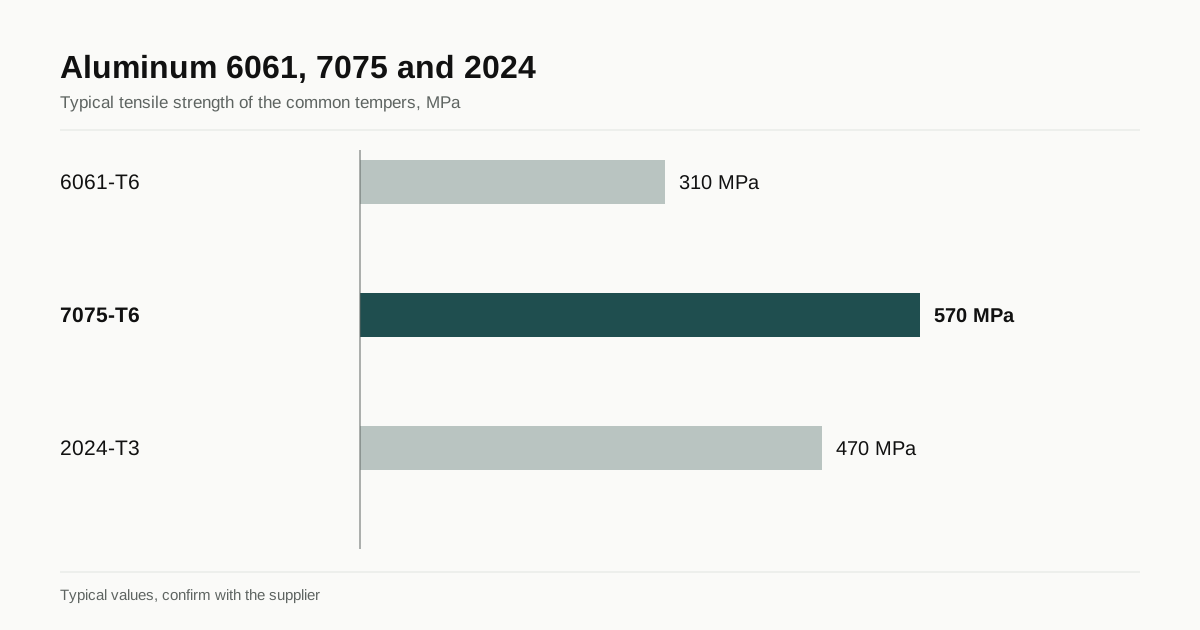
| Typical tensile strength | About 310 MPa | About 570 MPa | About 470 MPa |
| Typical yield strength | About 275 MPa | About 500 MPa | About 325 MPa |
| Density | About 2.70 g/cm3 | About 2.81 g/cm3 | About 2.78 g/cm3 |
| Corrosion resistance | Good | Fair, sensitive in some tempers | Fair to poor, often coated |
| Fusion welding | Yes | No | No |
| Anodizing | Even, predictable | Works, color can vary | Works, needs attention |
| Machinability | Good, can be gummy | Very good, clean chips | Very good |
| Relative stock price | Baseline | About 1.3 to 2 times | About 1.3 to 2 times |
All strength numbers are typical handbook values for the stated temper, and they vary by product form and thickness. Check the mill certificate for the batch you buy.
6061: the default
6061-T6 is the general-purpose choice. It is strong enough for brackets, housings, fixtures and enclosures, resists corrosion well, welds and anodizes cleanly in clear and in color. It is stocked in bar, plate and extrusion in almost every size.
On the machine, 6061 is easy to cut but can be gummy: the chips stick and stringy swarf wraps around the tool. Shops control this with sharp, polished tools, high speeds and good coolant. A prototype in 6061 usually costs the least of the three, with the shortest lead time.
Good for: form and fit models, enclosures, general brackets, anything that will be welded or anodized in color and early test builds.
7075: when strength decides
7075-T6 is much stronger and stiffer in practice than 6061. It is the alloy behind many aerospace fittings, high-load brackets, camera and drone parts and sporting goods. It machines very cleanly with short chips, and it holds a sharp edge and fine detail well.
The trade-offs:
- Cost. Stock costs more and shops often have less on the shelf.
- Corrosion. 7075-T6 is more sensitive to corrosion and to stress corrosion cracking in some conditions. Over-aged tempers such as T73 improve this at some loss in strength.
- No fusion welding. Welding degrades the alloy and usually cracks it.
- Anodizing color. Color can be uneven, and dark dyes can show variation between lots.
Good for: stressed brackets, tooling, fixtures, drone and robotic parts, anything where weight and stiffness count.
2024: for fatigue and damage tolerance
2024 is a copper alloy used in aircraft skins and structure for its fatigue behavior. It machines well and has good strength, but it corrodes more readily than 6061, and the usual practice is to coat it, anodize it or buy it clad. It does not weld by normal fusion methods.
On a prototype, you pick 2024 mainly because the final design calls for it. If the production part will be 2024, a prototype in 2024 gives the closest behavior in test, finish and machining. If not, 6061 or 7075 is usually the better choice.
Good for: parts that will be made in 2024 in production, structural fittings where fatigue matters.
Picking an alloy
Use this order of questions:
- Will the part carry real load? If no, use 6061. If yes, check whether 6061 meets the stress with margin. If it does not, use 7075.
- Will the part be welded? If yes, use 6061.
- What will production use? If the production alloy is known, prototype in it for any strength, fatigue or finish test.
- What finish is planned? For color anodizing, 6061 is the safer start. For hard anodizing, any of the three works, with differences in thickness and look.
- How soon do you need it? 6061 is on the shelf at most shops. 7075 and 2024 may add days.
Temper and product form
The temper tells you the heat treatment: T6 is solution treated and artificially aged, T651 and T6511 add stress relief by stretching, T73 is overaged for corrosion resistance and T3 and T351 are common for 2024. Stress relief matters for 5-axis parts, because a block cut on several faces can twist when internal stress is released. Plate sold as T651 and bar as T6511 is more stable. Ask the shop what it uses.
Cast tooling plate, often sold under trade names like MIC-6, is stress-relieved and flat. Shops use it for fixtures and plates that must hold flatness, and it costs more than rolled plate. It is not a drop-in for 6061 in strength-critical parts.
Finish and appearance
| Finish | 6061 | 7075 | 2024 |
|---|---|---|---|
| As machined | Good appearance | Very clean surface | Good appearance |
| Bead blast | Even matte | Even matte | Even matte |
| Clear anodize | Even | Works | Needs care |
| Color anodize | Even, many colors | Can vary | Can vary |
| Hard anodize | Common | Common | Common, check with the finisher |
| Chem film | Common | Common | Common |
Tell the shop and the finisher the alloy and the temper. Finishing costs often add a minimum lot charge, so group parts when you can.
What the alloy does to the quote
Aluminum alloys all cut fast, so machine time differences are small. Price differences come from stock cost and availability. As rough orientation, the stock for a small part is a minor part of the quote in 6061 and a bit larger in 7075. The bigger effect is on the schedule if the shop has to order bar or plate.
Checklist before you send the RFQ
- Alloy and temper written out, for example 6061-T6 or 7075-T651.
- Whether the part will be welded.
- Finish and color if any, including hard anodize if needed.
- Mill certificate requirement.
- Production alloy, if different from the prototype.
- Tolerance on features likely to move after stress release.
Send the part through the RFQ page. We match it with up to three 5-axis shops, and you get a reply within 24 business hours.
Frequently asked questions
Which aluminum is best for a first prototype?
6061-T6 in most cases. It is widely stocked, cuts easily, anodizes well and costs less than 7075. Use 7075 when the part is stressed, and 2024 only when the final design calls for it.
Can I prototype in 6061 and produce in 7075?
For fit and form, yes. For strength tests, no, since 7075 is much stronger and stiffer parts behave differently. Test in the alloy you plan to ship, or at least note the difference in the test report.
Does the alloy change the anodizing result?
Yes. 6061 gives an even, predictable anodized finish. 7075 anodizes but can come out darker or less uniform, and 2024 needs care because of its copper content. Tell the finisher the alloy.
Need this prototype quoted?
Send the drawing. We match you with up to 3 5-axis shops and reply within 24 business hours.
Get matched with a 5-axis shop