Guides / Process
Aerospace Bracket Prototypes: 5-Axis Parts Before Qualification
October 18, 2026
Brackets hold up the unglamorous parts of an aircraft: wire harnesses, hydraulic lines, avionics trays, seat rails and fairing attachments. They are simple in purpose and demanding in practice. Every gram counts, the load paths are specific and each bracket has to fit its neighbors within tight margins. Before a bracket goes into qualification, engineers build prototypes to check the design.
This guide covers what 5-axis machining offers for bracket prototypes, which materials teams use, what records matter and what to ask the shop. It is general information for civil and commercial aerospace work and not a regulatory guide.
Why brackets suit 5-axis
A typical aerospace bracket has pockets on several faces, holes at compound angles, thin ribs and tight datum features. Machined from a solid block, a good part may start at 10 times its final weight. A 3-axis process needs several setups to reach all the faces. A 5-axis machine can reach most of them in one or two clampings, with short, stiff tools. Benefits include:
- Pockets and webs cut from the best tool angle, which helps wall quality.
- Holes drilled square to angled faces, important for fastener seating.
- Features on different faces keep their relationship, since fewer re-clamps are needed.
- Faster change between revisions, since the fixture stays the same.
See done-in-one machining for how a single setup works.
Typical materials
| Material | Typical use | Notes |
|---|---|---|
| Aluminum 7075-T6, T651, T7351 | Structural brackets, fittings | High strength, check temper for stress corrosion needs |
| Aluminum 2024-T3, T351 | Fatigue-critical parts | Needs a protective finish |
| Aluminum 6061-T6 | Secondary brackets, trays, fixtures | Easy to cut, good corrosion resistance |
| Titanium Ti-6Al-4V | High-load, high-temperature, corrosion-critical | Slow cutting, costly stock |
| Stainless 17-4 PH, 15-5 PH | Fittings, pins | Aged after machining |
| Plastics such as PEEK | Insulators, spacers | Light, non-conductive |
The aluminum comparison is in aluminum alloys for 5-axis prototypes and the titanium comparison is in titanium prototypes on 5-axis.
For a first fit or ground test, many teams use 6061 or 7075 even if the final bracket is titanium. Do that only if the test does not depend on strength or weight. Production material or a substitute lists which tests allow it.
What changes between a prototype and a qualified part
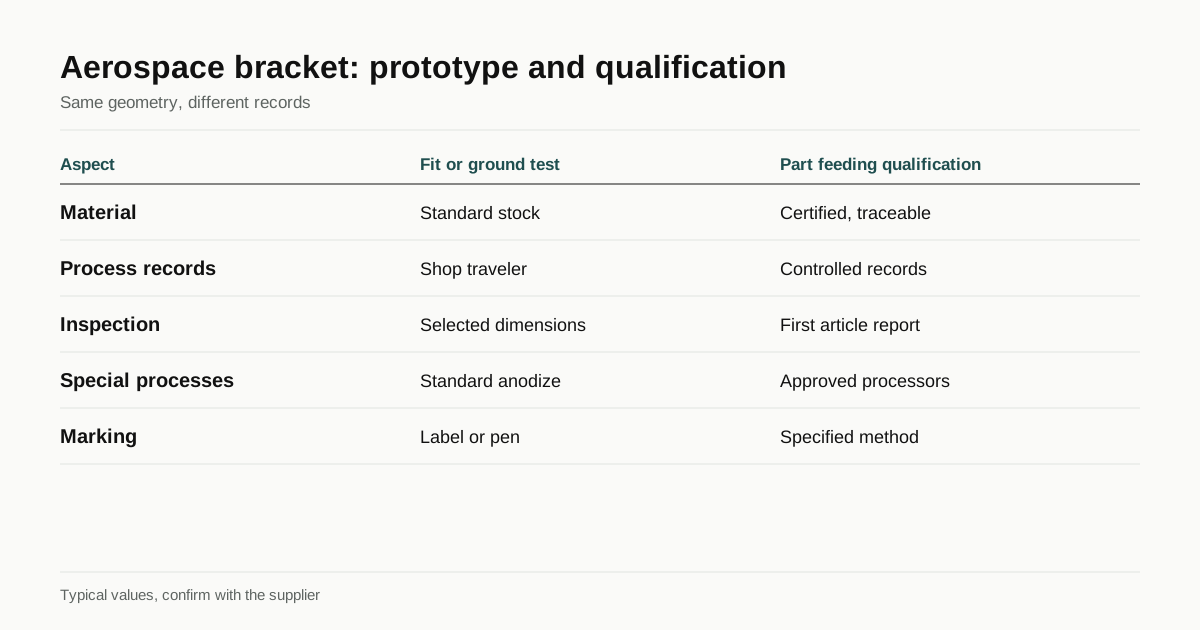
A prototype bracket and a qualified bracket can look identical and be treated very differently. The difference is not the geometry but the records and processes around it.
| Aspect | Prototype for fit or ground test | Part feeding qualification |
|---|---|---|
| Material | Standard stock, certificate on request | Certified stock with heat-lot traceability |
| Process records | Shop travelers, informal | Defined process, controlled records |
| Inspection | Selected dimensions | First article report to the customer’s format |
| Special processes | Standard anodize or chem film | Approved processors named by the customer |
| Marking | Part number by pen or label | Specified marking method |
| Documentation | Drawing and STEP file | Drawing, specification callouts, certificates |
You do not need the right column for early builds. You do need to know when you will move to it, because a shop that is fine for prototypes may not be able to supply the next stage, and changing shops between stages costs time.
First article records
Aerospace customers often require a first article inspection report. A common format follows SAE AS9102, which defines the forms and the content: part number accountability, a list of the materials and special processes used and a record of every drawing characteristic with a measured value. Not every prototype needs a full report, but if the program will require one, start talking to the shop early. Ballooning the drawing, which means numbering each dimension, is the usual first step and can be done by you or the shop.
Special processes
Anodizing, chemical conversion coating, plating, heat treatment and non-destructive testing are special processes in aerospace terms. Customers often require approved processors for them. A prototype shop usually sends these out. Ask what the shop does in-house and what it sends out, and who holds the approvals the customer needs. We do not verify approvals, so confirm them directly with the shop.
Design points for brackets
- Define the load path. Webs and ribs that carry load should be thick enough to machine without vibration. A web thinner than about 1 mm in aluminum is hard to hold.
- Give pocket corners a radius. A corner radius that fits a 6 mm cutter is far cheaper than one that needs 2 mm.
- Control pocket depth. A depth beyond four times the cutter diameter needs long tools and slow cuts.
- Mark fastener faces. Flat, square seating surfaces for bolt heads and nuts need a tolerance and a surface finish note.
- Plan for stress relief. A thin-webbed part machined from thick plate can twist when it is released. Stress-relieved plate and a rough-then-finish sequence help.
- Mark the datum structure. Dimension from the faces and holes the part locates on in service, not from convenient CAD surfaces.
More detail is in designing parts for 5-axis machining.
Tolerance expectations
For brackets, many features sit at ±0.1 mm, with hole positions, bore sizes and fastener faces tighter. The tolerance and inspection page covers how shops measure these, and how to avoid over-specifying. 5-axis prototype tolerances and inspection is the reference.
Export and data handling
Some aerospace drawings fall under export control rules. If yours does, say so in the RFQ and do not upload controlled technical data to a general form. Ask your compliance team how to share it, and ask the shop what it can accept.
What it adds to the quote
| Driver | Effect |
|---|---|
| Material and certificate level | Certified aerospace stock costs more and takes longer to source |
| Pocket depth and web thickness | More tools, slower cuts, more programming time |
| Inspection report | A full report on a complex bracket can add many hours |
| Outside processes | Anodize, coating and NDT carry lot minimums and lead time |
| Quantity | A single bracket carries all programming and setup |
Working with the shop on a first article
If you expect to need a first article report later, tell the shop at the prototype stage. A shop that knows the drawing will be ballooned and inspected can record the right measurements on the prototype and reuse the inspection plan on the qualified parts. Share the drawing revision and note which characteristics are key. Ask what measuring equipment the shop uses for each type of feature and whether its calibration records are available. If the shop sends parts out for anodize or coating, ask for the processor’s name and the specification used, and keep the certificate with the part record. A small amount of paperwork discipline at the prototype stage prevents a rework cycle when the program moves from test parts to parts for qualification.
Checklist before you send the RFQ
- Material, temper and specification.
- Certificate and traceability requirement.
- Finish and the special processes needed, with any approved-processor requirement.
- Inspection level: selected dimensions, measured report or first article.
- Marking requirement.
- Whether the part is export controlled.
- Quantity now and the next stage.
Send the part through the RFQ page. We match it with up to three 5-axis shops, and you get a reply within 24 business hours.
See also: AS9100 explained for what the certificate covers and when a prototype needs it.
Frequently asked questions
Can a prototype bracket be used on an aircraft?
No. Parts for flight come from an approved production process under the design authority's controls. A prototype bracket is for fit, ground test, load test and design review only.
Does the shop need AS9100 for prototype brackets?
Not always. Early fit and test builds often do not. Builds that feed qualification or first article reports may need a supplier with a defined quality system. Ask each shop what it holds and check the documents, since we do not verify them.
Why are aerospace brackets pocketed so deeply?
To reduce weight while keeping stiffness. Thin webs and ribs carry load with less metal. That geometry takes many tool changes, long cuts and careful clamping, and it is where 5-axis helps.
Need this prototype quoted?
Send the drawing. We match you with up to 3 5-axis shops and reply within 24 business hours.
Get matched with a 5-axis shop